A Simple Polarization Example
Ordinary visible light is a mixture of many kinds of waves. The light that enters your eye is composed of waves of a multitude of different wavelengths.
Each of these different waves vibrates in many different directions as the light travels.
" Whenever We Change a Beam Of Light Waves So That Many Of The Waves Are Vibrating In The Same Direction, We Have 'Polarized' The Light Beam."
Let's use Polarizing sunglasses for example:
We perceive light waves that vibrate horizontally as 'glare', on polarizing sunglasses, there are many tiny vertical scratches that allow only light wave that vibrate vertically through those tiny scratches. Light vibrating in other directions has a hard time getting through. In particular, horizontally vibrating waves will be stopped completely. Since they are the cause of glare, polarizing sunglasses will stop the glare waves. The light that went through the other side of the glasses is polarized. (light waves vibrating the same direction)
The actual description of light waves and how they vibrate is a great deal more complicated than has been made out here. Electromagnetic wave properties can be described mathematically, and seem to share the qualities of both a particle and a wave, as you may have learned or will be learning in your Physics class.

Make Your Lazy Dog Smile in One Single Step
5 Most amazing Rubik's cube patterns (Especially no tricks)
Maximum Material limit and Minimum Material Limit
Shaft
Consider a shaft with a dimension given by 50(±
0.05). Then the shaft is said to have a
Maximum Material Limit of 50.05mm because at this limit the shaft have maximum
possible amount of metal. The lower
limit 49.95 is the LML of the shaft, because of this limit the shaft have
minimum amount jkof material.
Hole
In the case of a hole, the conditions are
reversed because a hole of size 50(±0.05), the MML is when lower limit is at
49.05mm because as the lower limit increases the thickness of the hole increase
and material needed for producing the hole increases.
The LML is at 50.05 because at their limit the
material needed for the hole is minimum.
Limits, Fits and Tolerance
Limits
In a manufacturing industry, it is not
possible to produce a part with required accuracy. It will consist of some error, because in
mass production, a large number of parts are to be made with different matches
by different operators. So, in mass
production, accuracy increases the cost ofk production and time kof production.
So it is obvious that some permissible
variations is allowed for manufacturing a part without affecting their
applications. The 2 limits of allowable
variation from the basic size is known as Limits.
Tolerance
Tolerance is the permissible variation in the
size. That is the difference lbetween
higher limit and lower limit of the part.
Depending upon the size, the tolerance is of 2
types.
a) Unilateral tolerance
Here the tolerance will vary in only one
direction of the basic size, either positive or negative.
b) Bilateral tolerance
Here, the tolerance is allowed to vary in 2
directions of the basic size.
Fits
Fits are defined as the looseness or tightness
of the 2 matting parts (hole and shaft).
So a fit will result in a movable or fixed joint.
Types of Fits
a) Clearance Fit
When the lower limit of hole is larger than the
jkupper limit of shaft then the fit is said to be clearance fit. Here hole and shaft have relative movement
with each other.
Examples: Slide
fit
Easy
slide fit
Running
fit
b) Interference fit
Here the lower limit of shaft is larger than
the upper limit of hole. So lno relative
movement is possible in interference fit.
Examples : Force
fit
Tight
fit
c) Transition fit
Here the limits of the hole or shaft lies in
between the other. It is the fit lines
in between clearance and transition fit.
Examples: Push
fit
Wringing
fit
Wringing of slip gauges
When one slip gauge is placed over another, some air gap is present in between them. This air gap will affect the accuracy of the measurement. So we need to avoid this air gap. The process of removal of air is called wringing.
Procedure for wringing
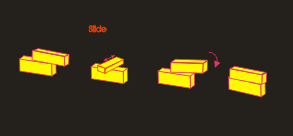
i)
Clean the slip
gauge with lint free cloth or cleansing tissue.
ii)
Move one slip
slightly over the other with light pressure.
iii)
One gauge is
place over the other 90o and then it is turned until the gauges
align in one line.
The gauges are adhere together. Adhesion is due to molecular attraction and
atmospheric pressure.
DOWNLOAD THIS DOCUMENT AS PDF
DOWNLOAD THIS DOCUMENT AS PDF
Slips Gauges
DOWNLOAD THIS DOCUMENT AS PDF
Applilcation of slip gauges
Slips gauges are gauge blocks which
are universally accepted and standards of length. The idea of slip gauge is proposed by the
Sweedish Engineer Johanon. So they are
also called Johanson Gauges.
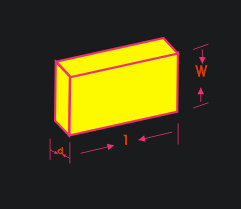
Slip gauges are highly polished
rectangular block. They are used for
high accuracy and close tolerance. They
are mainly manufactured with high grade steel but they are also made4 from
tungsten carbide which is extremely hard and wear resistance. For high accuracy, the working faces of the
slip gauge are made highly flat.
The cross section of thee gauges are
9mm x 30mm for their sizes upto 10mm. and 9mm to 35mm for larger sizes.
Applilcation of slip gauges
·
For accurate
measurement of work piece.
·
For checking the
accuracy of veenier callipers, micrometers etc.
·
Setting of a
comparator for a given dimension.
·
They are used
along with the sine bar.
Line standard and End standard
The measurement of distance can be
done by 2 methods.
a) We can measure the length as the distance
between 2 lines.
b) Or we can measure the length as the distance
between 2 parallel faces.
Depending upon this method of
measurement, the measurement kof distance is classified into 2.
1) Line Standard
If the distance is measured as the
length between 2 parallel lines it is called line standard. Examples: The scale is a good example for
line standard. A scale with divisions
shown as lines is used as the measurement.
Characteristics
of line standards
Accuracy is less because the thickness
of the calibrated lines on the scale is not taken into account during measure.
· Scale is quick and easy to handle over a wide
range.
· Scales are subjected to paralyse error.
· Scales markings are not subjected to wear.
2) End standards
When the length is measured as the
distance between 2 faces, it is known as the end standards. Examples:- Slip gauges, micrometer anvil, venier
calliper etc.
Characteristics
of end standards
·
High accuracy.
·
Time for
measuring is high and cannot measure 2 or more length simultaneously.
·
Subjected to wear
on their faces and because of that, we are forced to built the gauges with hard
materials.
·
They are not
subjected to paralyse error.
Concept of Entropy
Claussius
Theorem
Claussium
theorem states that any reversible cyclic path can be substituted by a reversible
Zig-Zag path between the end states but the condition is that the zig zag path
contains a reversible adiabatic process followed by a reversible isotherm and then a
reversible adiabatic .The heat transfer in the real reversible process and
substituted isothermal process must be same.
Consider a
reversible process as shown. According
to Claussius theorem, we can divided it into many reversible process consisting of a
reversible isotherm and followed by a reversible adiabatic. If we closely examine the process, each
closed zig zag lines can be called as a Carnot cycle.

So we can say that the reversible process is divided by a number of Carnot cycle.
Consider
the process abcd. there heat dQ1,
is absorbed reversibly at temperature T1 and dQ2 is
rejected at temperature T2.
dQ1 =
-dQ2 (-ve indicates dQ2 is
rejected)
T1 T2
dQ1 + dQ2
= O
T1 T2


The equation shows that the cyclic
integral of the ratio
for a reversible process is zero.
But in practical a reversible cycle is
never been possible and the integral term must have a value.
Classius call this value as
entropy. So entropy is the value of the
integral

So let us check it once more.

Second Law of Thermodynamics
DOWNLOAD THIS DOCUMENT AS PDF
The two
demerits for first law of thermodynamics are;
a) First Law doesn’t tells about how
much heat is converted into work.
b) It also doesn’t tell about the
direction of heat transfer.
Because of this reason, we are forced
for the second law which shows direction and amount of heat. There are w statements in second law.
Kelvin Planck statement
“It is impossible for a heat engine
to produce net work in a complete cycle if it exchanges heat only with bodies
at a single fixed temperature.”
The term efficiency is arising from
the Kelvin Planck statement. Efficiency
is the ratio of the output energy to input energy.
Consider a heat engine works between
2 heat energy Q1 and Q2 and does a work output Wnet

Where
Wnet = Q1-Q2
Q1 = Input heat
Q2 = Heat lost to sink
Then
efficiency= Output
Input
= Wnet
Q1
= Q1 – Q2
Q1
= 1 – Q2
Q1
All heat engine will have a heat
transfer Q2 with the sink. In
most of the case, the sink being the atmosphere.
If an engine which violates a Kelvin Planck
statement, then Q2 for that engine is zero.
Therefore Efficiency = 100%
Such a heat engine with 100%
efficiency is called Perpetual Motion
Machine of the second kind or PMM2.
Claussius statement
“It is impossible to construct a
device which operating in a cycle will produce no effect other than the
transfer of heat from a cooler to a hotter body”.
This law gives us the direction of
heat transfer that is from hot bodies to cold bodies.
DOWNLOAD THIS DOCUMENT AS PDF
DOWNLOAD THIS DOCUMENT AS PDF
First law of thermodynamics
It is considered as the general law
& nature. It states the conservation
of energy. That is Heat and Work are
mutually convertible.
Q
= ∆E + W
This equation shows that when we
apply a certain amount of heat into a system or taken out a corresponding work is
takes place and the rest of the heatis converted as the internal energy of the
system.
Internal Energy
Internal Energy is of 2 types. Macro and Micro.
Macro
The macro comprises of the kinetic
energy and potential energy of all the atoms in a system.
EMacro
= EKE+EPE
Micro
It is composed of all the small forms
of energy like rotational, translational, vibrational etc.
Consider an IC engine. When combustion in IC engine takes place heat
is forme and with the help of this heat expansion stroke takes place ie. the
work takes place. Here a lot of energy
is lost that is we cannot convert the complete heat into work, because heat is
a low grade energy and work is a high grade energy.
We cannot convert low grade energy to
high grade energy completely. But we can
convert the high grade energy to low grade energy completely with a small
amount of loss.
Zeroth Law of Thermodynamics
If a body
said to be in equilibrium three conditions must be satisfied.
a) Mechanical equilibrium : There is no external force must be acted on
the system
b) Thermal equilibrium : There
must haven’t any spontaneous addition of heat.
c) Chemical equilibrium : There
must haven’t any chemical reaction.
If these 3 conditions are satisfied
the system is said to be in thermodynamic equilibrium.
Consider the system A is an
equilibrium with B and B is in the equilibrium with C, then they are in thermodynamic
equilibrium with each other.
Application
One of the familiar application of
the Zeroth law is the Thermometer.
When we measure with a Thermometer,
we can see only 2 system thermometer and the system whose temperature is to be
measured. But there is a 3rd
system ie. the atmosphere.
So consider a system with temperature
(System A) is equilibrium with the atmosphere (System B). Consider the thermometer as system C which is
equilibrium with atmosphere. So the
thermometer and system with temperature is in equilibrium with each other
according to Zeroth law. So the
temperature shows on the reading is same as t
Thermodynamic process and properties and cycle
Properties
Properties
are the characteristics used to describe the condition of a system. Examples are Pressure, Temperature and
Entropy etc.
Depending
upon the change of a property with respect to mass, they can be divided into
two.
Intensive
property
Properties
which are independent of mass is called intensive property. Examples:- Density, Temperature, Pressure.
Extensive
properties
Properties
which are dependent on mass is called extensive properties. Example:- Volume, Energy.
Process
Consider a system with pressure P1 and volume V1. A change in volume V1 to V2
change the pressure P1 to P2 and volume reaches Vn. If we plot the graph of P vs V we get a curve
called path of the system. If the path
is completely specified, then it is called a process. Example:- Isothermic, Isobaric, Isochoric.
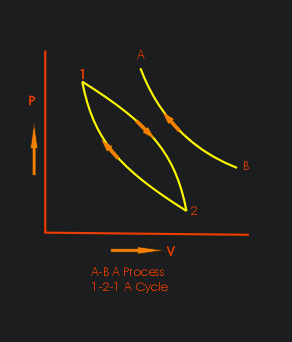
Cycle
When a process completes and finally come to its initial state then the process said to be a cycle
Subscribe to:
Posts (Atom)